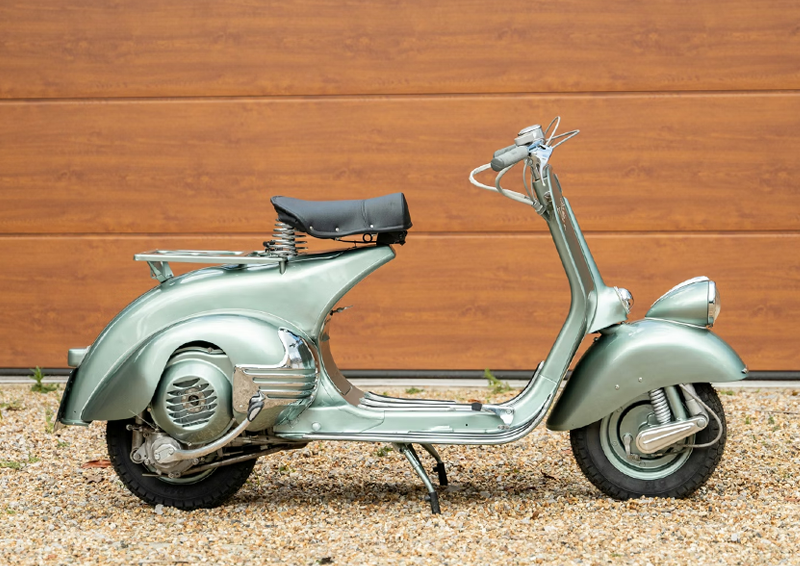
Vespa 125
Image source: https://collectingcars.com/
Last updated: 2025-12-17 15:35:19
Rarity Index
84/100
Very Rare
Factory Colours
1950–1952
-
Verde Metallizzato ("Metallic Green")Max Meyer: 6002M
Factory Primers
1 option-
Rosso Opaco ("Matt Red")Max Meyer: 10055M 1950–1952
year & frame ranges
-
1950V30-V33 ☆ 10,497 – 161,455
-
1951V30-V33 ☆ 125,811 – 231,133
-
1952V30-V33 ☆ 225,224 – 232,228
-
1952V30-V33 ☆ 230,196 – 251,280
Vespa 125
- Model
- Vespa 125
- Produced In
- Italy
- Production (est.)
- 147724
- Frame Prefix
- V30-V33
- Motor Code
- V30M
Engine & Performance
- Engine
- 2-stroke, single-cylinder, air-cooled
- Displacement
- 125 cc
- Bore × Stroke
- 56.50 × 49.80 mm
- Power
- 4.5 HP @ 5000 rpm
- Top Speed
- 70 km/h
- Mix Ratio
- 4%
- Transmission
- 3-speed
- Transmission Type
- Manual
- Clutch Type
- Wet - Multiplate
Chassis & Dimensions
- Frame Type
- Wideframe
- Frame Material
- Steel monocoque
- Fuel Capacity
- 5.0 L
- Length
- 1680 mm
- Width
- 790 mm
- Wheelbase
- 1160 mm
- Tyre (Front)
- 3.50x8
- Tyre (Rear)
- 3.50x8
- Brake (Front)
- Drum
- Brake (Rear)
- Drum
- Voltage System
- 6V
Carburettor
- Carburettor
- Dell'Orto TA 17 B
Model Images
20 photosClick a thumbnail to enlarge.
Related Videos
1 videoGeneral Overview
Notes
The V30-V33 series introduced several improvements over the preceding V1-V15 series:
Cable Gearshift: The primary difference was the switch from the complex internal rod-linkage (the "Bacchetta") to the simpler and more robust cable gearshift that is standard on classic Vespas.
Exhaust System: The exhaust was repositioned to run transversely between the engine swingarm pivot and the rear wheel.
Fuel Tap: The fuel tap was changed from a simple pull-rod to a lever with a knob, offering three positions: closed, open, and reserve (R).
Brakes: The rear brake drum diameter was increased to improve braking performance.
Engine Development (V33): Later in the series (starting with the V33), the engine transitioned from a single-channel to a dual-channel design, a significant performance upgrade for the time.
Cable Gearshift: The primary difference was the switch from the complex internal rod-linkage (the "Bacchetta") to the simpler and more robust cable gearshift that is standard on classic Vespas.
Exhaust System: The exhaust was repositioned to run transversely between the engine swingarm pivot and the rear wheel.
Fuel Tap: The fuel tap was changed from a simple pull-rod to a lever with a knob, offering three positions: closed, open, and reserve (R).
Brakes: The rear brake drum diameter was increased to improve braking performance.
Engine Development (V33): Later in the series (starting with the V33), the engine transitioned from a single-channel to a dual-channel design, a significant performance upgrade for the time.
Data can vary by market and year. Please contact us if you spot an error.